
…continued from Livelli, part 1
Having left Calce Viva with two tubs of aged and slacked plaster for my work as an abstract fresco painter, it was time for a bit of RnR. We’d heard of a public garden being developed by the Zizzi family in an abandoned quarry nearby. We’ve bought plants from the Zizzi nursery for years and have been very pleased with the quality of the plants and the knowledge shared with us there. The new garden is a gift to the community and a showcase for a wide variety of diverse plants.
When we got to the Giardino, we parked and stopped at the ticket office, and unsurprisingly, found we were the only visitors. One of the great pleasures of being in Puglia in the (very) off season is the scarcity of tourists. We were given a map of the large site, an explanation of the various planting areas, and an umbrella as rain threatened. We saw many very cool plants, some of which we easily recognized from our years here, and some—exotic species imported from afar—were new to us. Along the way we stopped to examine the walls of the old quarry.
Tufo had been mined at the site—a soft volcanic stone used for building for which it is cut into blocks. It is not as heavy, handsome or as difficult to work as limestone (from which the lime plaster is ground). Tufo is less expensive and easily adapted to a variety of projects. The denser limestone is now reserved for more demanding projects, and ones with larger budgets. Long ago, most buildings in the area were constructed from limestone and tufo was used sparingly.
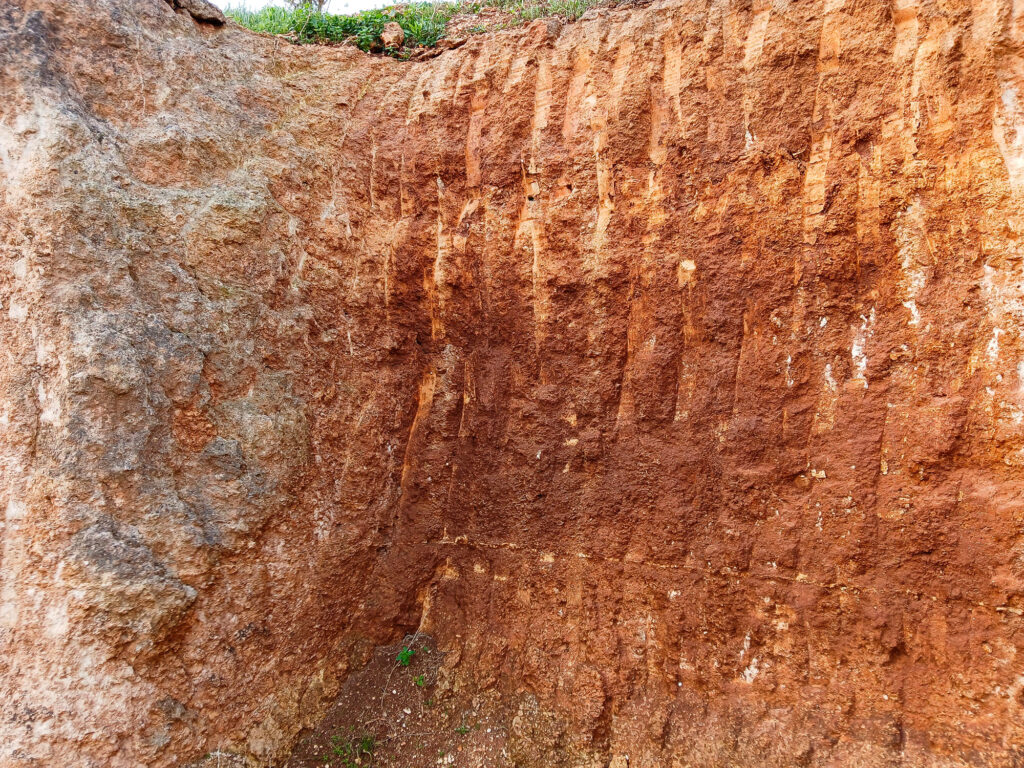
Looking at the quarry walls, I was still thinking about the layers of information and of the thin coats of plaster I layer on my paintings. Here the soil strata are incredibly thin, a few centimeters deep. At our place in the Pacific Northwest, the rich forest humus soil extends down and down, far further than our shovels can reach. Here shovels are rarely used because stone is encountered very quickly, rendering the tool useless.
The first Sunday we were back here this time around happened to be the monthly edition of the so-called mercato antiquario, which of course we took in. I came away with an eight-euro illustration from an old book showing the levels of Purgatorio, as described by Dante. The print depicts Purgatory as if it were a cup around which are inscribed the many livelli to which sinners have descended. More layers, each labeled by the poet.
Fresco, the art of painting with pigmented plaster of 500 years ago, also had names for the layers laid down as the paintings took shape. My version proceeds without names, though I follow a rigamarole I’ve developed for layering the thin coats of plaster on the primed poplar plywood. Named or not, I put down several very thin coats, each pigmented, one after another. Drying must occur between each, which adds another variable- going back into an incompletely dry layer leaves signs that I find appealing. My work as a painter involves covering and uncovering traces I’ve left on the surface.


The cartoon, as it is called in English, or the sinopia, as it is termed in Italian, was the drawing put down by the fresco painter in the early stages of composition. It provided a schema for the figures he’d paint in subsequent layers. I don’t put figures in my paintings, and my sinopia is not intended to guide the later levels. But I am always intrigued to bring up to the final surface elements or fragments of earlier imbedded drawing.
For me, painting with plaster—as I was recently reminded by a close watcher of my work—is a kind of (inside/out) archaeology wherein I create, bury and then re-discover what I’ve already done. So, in a roundabout or maybe even direct way, my painting in Puglia responds to the layered presence of information here. I’m always looking intently when I paint but am rarely sure what I’ll find. Sometimes the paintings manage to reveal truths I’d neither sought nor knew to have existed; when that happens, I’m delighted. The wonder of surprise is Ne plus ultra.