

Back in Puglia, and back at work in Studio33, I was getting very near to the bottom of the bucket of plaster from Calce Viva in nearby Fasano, my mainstay. I needed to replenish the studio supply, but last spring, when I visited, I found the sprawling place in disarray and nearly deserted. On that visit, the signora in the office told me she and her brother, having inherited the business from their father who founded it in the 1940s, were ready to retire and seeking a buyer.
I called the office a couple weeks ago and she answered. When I identified myself and told her I was looking for 25 kgs of their Marmino ExtraFine, she gave me her brother’s number saying he would know if any were ‘available’. I telephoned and was told he’d have an answer in a few days, if not the product itself. When I called again, he said he’d found what I wanted and to come by Friday morning.
We decided to make an excursion of the procurement trip- after picking up the plaster at Calce Viva, we’d visit a botanical garden being developed in an abandoned quarry nearby. When we arrived at Calce Viva, I drove to the back of the extensive property, past heaps of aging lime plaster, the enormous brick kilns, several outbuildings and two barking dogs. When I got to the laboratorio, where they used regularly to put up the aged lime plaster in buckets, there was nobody.
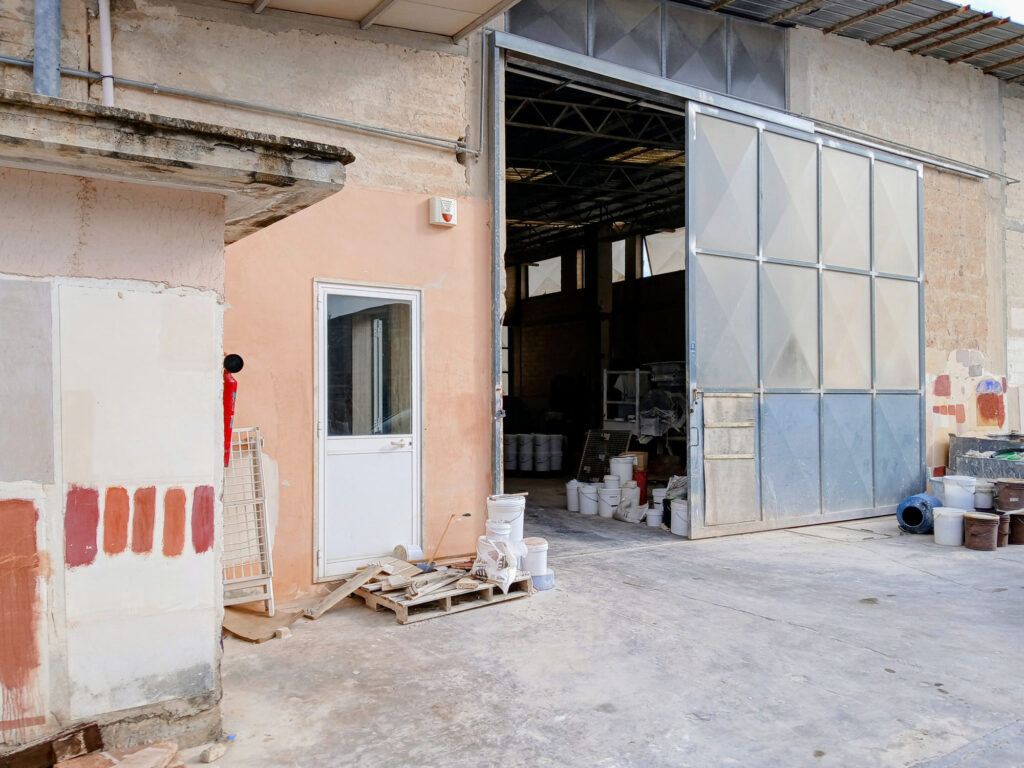
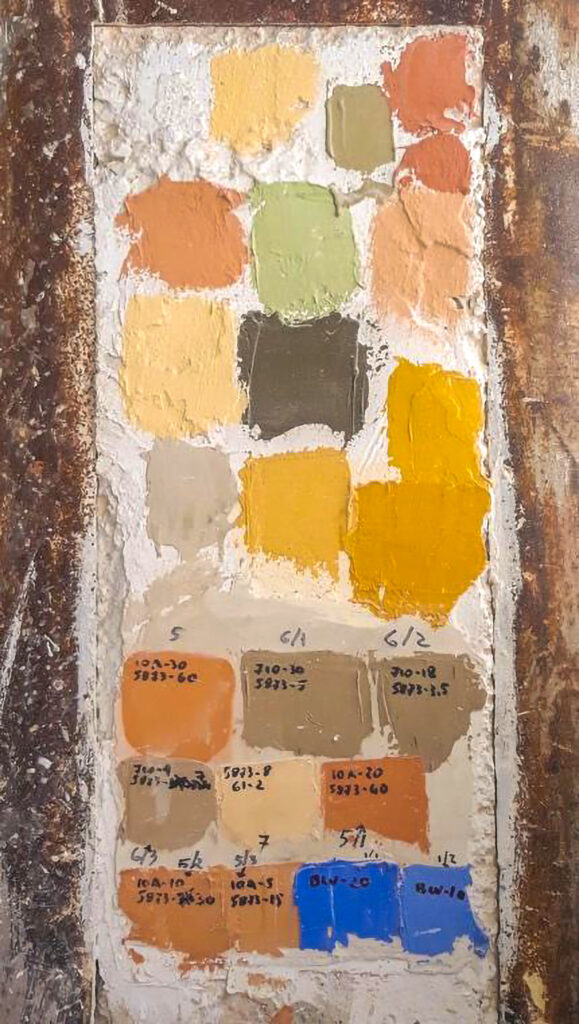
I called Elario again, half-owner of the business, and he said he was on his way…. In the meantime, and since the door to the laboratory was open, I did some exploring, inside and out, some snooping and picture-taking. The interior and exterior walls of the building and the walls nearby display ample evidence of color matches being tried out. Some were done years ago.
He arrived and showed me the bucket of Marmino ExtraFine he’d found. Not far from it I saw one labeled Marmino UltraFine. When I asked about it, Elario told me it was the most finely ground of the plaster slurries they produce and was quite wonderful. I bought that bucket as well and hefted the two into the back of the borrowed Fiat Panda. On the way to the giardino, I chuckled thinking about my layers of history with them, and the information they’ve shared with me.

When I first decided to use lime plaster as a painting medium in my Pugliese studio, I did research and discovered that Calce Viva was not only close by but specialized in producing plaster aged and slacked in the time-consuming 500-year-old traditional Italian way.
The young man who anchored the sales counter in those days told me I should start with their Medio (medium) plaster (which is called Marmino because it has marble dust mixed in for luminosity) and then use the Fine in thin layers over it. I bought both, along with their Primer, with which to first coat the poplar plywood I intended to use as a painting support. This combination served me, with some refills, for the first years of my self-apprenticeship. I’ve always bought bianco plaster, uncolored, and added pigments as I use it.
Then, on another visit to Calce Viva, I discovered their Marmino ExtraFine, very finely ground and smooth, which I used quite happily for final coats over the next decade. I had no idea they offered an even more finely ground plaster. Now I know, and it spreads like butter. As they perhaps go out of business, I am getting to the bottom of, or better said, the top of their product line.
All this is very Pugliese: the ‘truth’- always relative here, and perhaps with actual relatives even rarer, is portioned out slowly, a bit at a time. This endlessly extends relationships and the stories that flow across them like water in the desert environment. There is never a hurry, and no need to be definitive about much of anything. Since the truth is murky, if it even exists, why try and plumb its depths, which can barely be seen? Might as well lurk around the edges in conversation, enjoying the give and take, and the occasional epiphany.
I wasn’t told about their UltraFine plaster, not because it was being hidden from me intentionally, nor because it was felt to be beyond my capacity or desire. Since I didn’t ask for it, apparently, I was doing just fine using ExtraFine, which in fact was the case. Now that I have 55 lbs of UltraFine, which I will use a couple spoonfuls at a time in my pigment-plaster-water-linseed oil mixture- several years will pass before I stop experimenting with it.

Painting for me has always been about trial and error- trying out materials and approaches and modifying how I produce the art I make. It’s not that I have or ever have had a predetermined goal in mind. Since I’m headed nowhere exactly, I’m not looking for a specific technique or material to get me ‘there’. Rather, I do the mess around, as Ray Charles used to sing about. And it’s messing around that delivers the pleasures, the challenges and the solutions.
The painting journey transports me. Some days I feel even more blessed than other days- what I’m making just seems to make itself and, in the process, makes me very happy. Having top-notch (as our son Benjamin likes to say) materials can make the process even more delicious. But using less than ultra materials also has its own rewards, as made evident by the Italian Arte Povera movement of the 1960s.
Read more in part 2…