
We were having breakfast of idli and omelets with the Prince and Princess, when Usha (the lovely Princess) asked if we were familiar with the Italian book The Conscience of Zeno. There was to be a book launch that evening celebrating its translation into Malayalam.
Knowing the translator, she’d been invited, and asked if the three of us wished to accompany her. Kocha, her terrific Prince, pulled a face, Patri remained silent, and I said that while I had read the book in both Italian and English, I wasn’t sure listening to a talk in Malayalam, which I don’t speak, would make much sense.
What followed was a typically fascinating discussion from our time with them at their wonderful country house outside Trissur, in Kerala. It turned out that the translator himself didn’t read Italian, but it also happens that I am much taken with Zeno’s Paradox, from which the book’s premis derives, and which suggests why going from English to Malayalam was near enough. I explained my Trieste-based knowledge of Italo Svevo, the (pseudo-named) author of the book in question, one of the very first ‘modern’ novels, where nothing happens, but does so bit by bit, championed by none other than James Joyce, who was Schmitz (Svevo)’s English teacher in Trieste, where he was writing Ulysses, set in Dublin where he wasn’t and to which he would not return.
Zeno’s Paradox, which he posited 2500 years ago, states that while we can get close to our destination, we can never quite reach it, since it always remains half the distance away, an amount we cannot, Zeno hypothesized, ever overtake. In Southern India today, as surely in the time of Zeno, nothing is quite fully approachable, nor are the veils surrounding everything able to be completely parted. We were staying with Kocha and Usha half-way through our recent three week return to Kochi, where we hadn’t been in a decade, but where we were to discover we’d never left. Lost in our attempts to move forward despite never quite getting there, we were having, and were to continue to have, a splendid time.
As far as I know, Zeno didn’t consider the role of memory in his paradox, but surely the inability to remember things could and likely would impede one’s progress (or regress) towards getting there again. In their novels, Joyce and Svevo both managed the disconnect between what was and what was remembered by messing with both past and present.
Being back in Kerala, which I thought I had much forgotten, I was struck by how much I remembered. And when we traveled to Kochi in the last leg of our trip, this was brought home (so to speak) by how many people rushed out in the street to hug me and welcome us back!
It was another breakfast with the royal couple, where the discussion centered on memory itself. Kocha, a medical doctor and 87, is very sharp. Usha was kidding him about how taking Brahmi had helped him stay that way. Having not heard of it, I asked about Brahmi and without fully explaining, he said that it was an extract of a plant that Ayurvedic medicine has long promoted as mind sharpening. He remarked, in his usual good humor, that he wasn’t sure if it had done anything for him, but since Usha claimed it had, he was going to keep taking it. He said, seemingly half-jokingly, that it could just be a placebo. I said that, placebo or not, I liked the idea of my mind being plant sharpened. We laughed about how it didn’t really matter if one thought one remembered more or if one did, and later that day I was presented with two bottles of the Brahmi caps.
Usha and Kocha’s openness, geniality and generosity were echoed throughout our Indian visit. After we left their sublime hospitality, we spent another week in the remarkable house built by our longtime friends Anoop and Dorrie. Tragically Anoop passed away a few years ago, much too young, and Dorrie, once the unequivocable doyenne of the Cochin café and contemporary art scene, is now constructing a new house and a new life far up in the Keralan ghats, the lush mountains that bequeathed black pepper to the world. She descended to sea level to open the house and welcome us.
Her Kochi house is down a narrow lane, which meant we arrived there on foot. After a couple days, we were greeted as neighbors, given open smiles and morning greetings as we walked the lane to the thoroughfare where we could catch a tuktuk. We’d spent our first week in the small river town of Aluva, staying in a large new villa loaned us by an acquaintance of our host, the noted Professor PJ Cherian. The grandiose house was sterile and empty, save beds and a few not very comfortable places to sit. It offered none of the grace, charm, history or personality of either Usha and Kocha’s handsome 1915 house or Dorrie’s more modern/traditional marvel. But it was loaned us with kindness and provided a quiet place to sleep.
Cherian’s own house, a short walk from the villa, where we spent many hours in discussion and animated argument, was human-scaled and welcoming. Built by him, it sits across from the Periyar River, which drains to the Pattanam archaeological site that Cherian directed for 15 years. He’d invited me to become the first artist in residence at PAMA, the research institute he runs. PAMA is Cherian’s effort to provide context and raise visibility for the cache of fragments he and his team unearthed from the Indo-Roman trade of 2000 years ago. Having spent almost half a century looking at trade around the globe, it seemed a fine offer. And it was.
Cherian is a brilliant historian and archaeologist, and I’ve worked with several of each over the years. But none were as obsessed, contentious and defensive about their discoveries. Zeno seemed to be with us wherever our conversation wandered, and wherever it took place. We never seemed to be viewing things from the same point of view, though our looking often closely overlapped. On my part, this was not unexpected, having had a stream of on-line messages and phone contact with him. I had hoped that our passion for examining the ancient trade would make up for our different agenda. And in fact, that was the case, though a couple times we almost got into fisticuffs. Nonetheless, fighting it out from our respective positions proved highly productive- sharpening the overarching argument about how best to present the findings to the world. I learned a good deal tussling with him and suspect he did as well.
Up in the open loggia on the second floor of his house, there hangs a large photograph of Cherian’s mother, an intelligent looking woman. That same portrait, just as large, adorns one of the two tiny rooms in the primitive ‘hut’ at the dig site itself. The other room of the hut features an even larger reproduction of a painting of the very dramatic bloody killing of Gandhi. The artwork takes up most of the wall space in the small room, and having gotten to know Cherian, we had little trouble surmising why it was there. Patri and I spent the night at the hut to get an idea of the Pattanam site itself. It wasn’t a restful night, since we ‘slept’ on narrow wooden planks, but lack of sleep was a fair price to pay for insight into the place.
The dig is now shut down, for reasons too complex and convoluted to recount here, and Cherian has plenty of reasons to be all riled up. But even closed and covered, from our visit in-situ we got a good sense of how it’d been carved out of dense aqueous mass. Pattanam was a fabled port when it was known as Muziris, until the Roman Empire collapsed, and ships stopped calling. Silted up, it vanquished forgotten for centuries. Nature took over, greening out the mud, since in the moist fecund South Indian climate, vegetation grows rapidly, reaching great height and density in very short time. In the scheme of things, it was not that long ago that villagers hacked their way to establish their small holdings. And after years of finding odd old bits they dug their gardens, Cherian and his team set out to systematically examine the soil. So far, they’ve worked only 10% of the site.
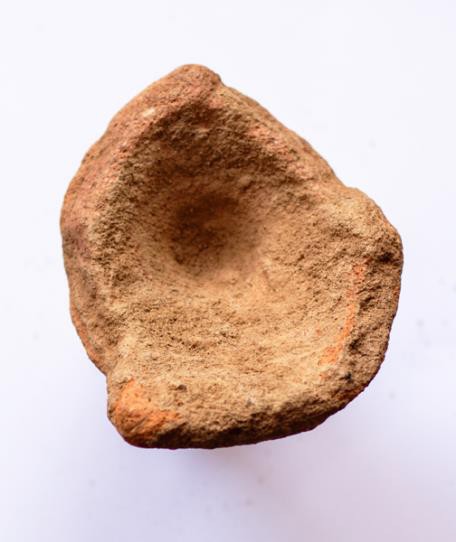
Large plastic bags full of discarded pieces of the terracotta fragments leaned against the outside walls of the hut. In the morning, I photographed some. Cherian had explained that with chemical analysis, the clay types can be identified, thus determining the locations where the amphorae were made. Most of the terracotta vessels came from Southern Italy, very close by to our Pugliese digs. The analysis also reports on what substances they held- vino, garam, as it was called in India (fish sauce made from fermented anchovies), and olive oil.
Nowadays, most of the world’s fish sauce is produced, consumed, and exported in SE Asia. But two millennia ago, it arrived from Italy, offered up in trade primarily for black pepper, which growing solely in the Kerala ghats, was viewed as a great luxury in Europe. Now piper nigrum has been transplanted and is harvested elsewhere.
When we left Kerala, we flew to Qatar and then on to Rome. We stayed in the capital for a couple days to catch up with friends and take in a vast and exhilarating Futurism exhibition. Because of the looming presence of ancient amphorae there, we decided to stay out at Testaccio. The neighborhood is named for Monte Testaccio, an enormous 2000-year-old garbage heap, masquerading as a large ‘artificial’ hill, built up from the pieces of an estimated 53 million amphorae. The same rubble we’d seen in bags at the hut, they are called testaein Latin, thus bequeathing their name to the (very cool) Roman neighborhood. Zeno followed us, we could see the hill from throughout the neighborhood but never getting close enough to touch it.
Presumably some of the terracotta amphorae pieces that make up the sizeable and now overgrown hill traveled round trip to India and back and were discarded there. However, most apparently contained olive oil, which though it was traded to India, the bulk of the olive oil that arrived in Rome was consumed in the city, and then for reasons not fully understood, once decanted, the amphorae that supplied the oil were thrown on the heap.
Throughout our whirlwind Kerala visit, there was a good deal not fully understood by us. Beyond the density of vegetative growth everywhere, there’s the ever-present need to negotiate the thicket of ritual, custom, history, caste, politics and the vast swarms of people everywhere. Seeing, and even approaching understanding takes time, and our visit was brief. Having previously lived and worked in Kerala, we mostly knew our way around geographically. But our hosts were all keen on helping us figure out where actually we were.
Kocha and Usha are both descended from the Cochin Royal family. The last Maharajah of the region, who died in 1964, was Kocha’s uncle. It was he who blessed Kocha’s desire to go to university, study science and become a doctor. Until Kosha had done so, none of the royal family attended university since it was believed they needn’t and shouldn’t work, going off for advanced study was deemed superfluous
As part of their effort to fill out our ‘fund of knowledge’ as myuncle used to say, they took us to the Hill Palace, hear Kochi on our last day with them. Kocha told us that when he was a boy he hung out in the palace with his cousins and ran around. Since there has been no acknowledged royal presence in Kerala since Independence, the palace is now called a museum and open to the public. Our visit there occurred on a Sunday, a day off for most, so the old stone building was mobbed with crowds of folks strolling through the building and grounds.
The palace/museum is sparsely furnished, but the walls are full up with framed and painted portraits, large and small. They show the royal family throughout their history, mostly in formal sittings, but also at leisure. Usha and Kocha pointed out their young selves in some photographs. The building is showing its age, but the rambling gardens leading up to it are beautifully kept, full of fabulously varied flora. Having had my fill of looking at the old pictures and reading the odd lines of explanatory text, I wandered out to admire the plantings. Soon I was joined by the other three, since the museum was closing for lunch time.
We headed off to a vegetarian banana leaf restaurant, where eating was a solemn serious enterprise, also spicy and very good. After our repast, we climbed back in the car and the driver took us to see their quite nifty pied a terre close by a storied Hindu temple. The low-slung brick building was built by Kocha and his two brothers, each of them occupying a matching wing. In the bedroom of their unit, hung a pair of portraits, one of the last Raj, suspended at a downward angle towards the bed.
The cantilevered portraits seemed speak to a problem I’d encountered at the palace/museum – there was little to occupy the large spaces except the many framed pictures on the wall – and all being flat up against it, they became a kind of wall treatment that for me steadily went out of focus. In distinct contrast, at the end of our visit, we took in another museum with Balagopal (Bala to his friends, who now very much include us), where the walls and every other space and surface of the three floors were greatly, even overly activated.
I was introduced to Bala, a trustee of the PAMA institute, by Cherian, who we were to meet at his home. The professor and I arrived separately, Cherian driving from Aluva, me by tuktuk from Dorrie’s. Bala and his wife Vini received me warmly in their spacious Ernakulum flat overlooking a waterway that had necessitated my crossing two bridges from Kochi. The three of us hit if off immediately.
Bala invited me and Patricia to join he and Vini at their apartment for dinner later in the week, and we all had a fine time. As the evening began, we were joined by Jacob, a young man who Bala explained ran a fascinating private museum very close to their apartment. Jacob told us that the museum had been begun by his late father, an antiques dealer, he invited us to come visit and then left the four of us to spend the evening in conversation. As Vini said later, it was if we were new very old friends.
A few days later Patri and I decided to take in Jacob’s museum. We’d spent the morning in Ernakulum, the more modern city across the water from historic Cochin, now known as Kochi. We took the ferry, which has itself been modernized- when we first in Cochin years ago, the very funky wooden topped ferry was painted a fabulous pink inside.

I’ve long been fascinated by the Ernakulum shops and emporiums selling everything imaginable within a bewildering labyrinth of streets (at one point we were standing at the nexus of Jew Street and Muslim Street, where we remembered there’s a 12th century synagogue buried inside a tropical fish store and stopped in for a visit).
Patri had an appointment with her colleague Rajan, who runs the heritage wing of the local government, and I continued to wander aimlessly. We met up for lunch at one of our old haunts, to revel again in their scrumptious fish curry, which time away had only made better. And though my favorite activity after such a lunch is a nap, I texted Bala that we were going to take in the museum. He answered that he’d join us.
Though the museum is in Ernakulum, its roots are in Cochin’s Jew Town, the once ancient hub of Jewish spice traders at the Mattancherry port where long after Muziris was abandoned and disappeared, but still long ago, black pepper made its way out the Arabian Sea, up to Alexandria, and over to Venezia. The warehouses where the bags of peppercorns were stored, called godowns, then and now, are extraordinarily capacious, very long and high ceilinged. They opened to Bazaar Road and exited to waiting ships through their back doors on the sea. Twenty years ago, I repurposed an abandoned Mattancherry godown as a working studio.
Jew Town is now well known as a center for antiques gathered from Kerala and throughout India. The enormous godowns are crammed to the roofs with architectural pieces salvaged from old wooden buildings being constantly torn down in the name of progress. When I had my godown, I often stopped on the way home to sight-see through the antiques places. I rarely bought anything, but became good friends with several of the proprietors, who seemingly enjoyed our banter and fielding my queries about the amazing stuff on offer.
Jacob’s grandfather and father operated a large Jew Town antique business. Apparently, they made a great deal of money, enough that Jacob’s father could squirrel away a huge cache of old pieces for his museum. He used some of the larger historic structural pieces from 25 traditional buildings and took 7 years to build an edifice in Ernakalum in the form of a traditional Kerala wooden house. He stuffed it with all manner of flotsam, jetsam, bric and brac. Now run by Jacob, it’s called a folklore museum but really is a glorious paean to an ancient way of life. Patri and I were dumbstruck as we toured it with Jacob. I forgot entirely about needing a nap.
Towards the end of our museum tour (and the end of our Indian idyl), having cast our eyes over ornate and commanding religious statues and small intricate icons, mandalas, jeweled headdresses, elaborate necklaces, entire winding staircases, gorgeous teak ceilings, solid hunks of carved and joined furniture, embroidered silk costumes, delicately carved heavy teak doors and even Muziris amphorae, I was stopped dead in my tracks by a double portrait painted in oil. Jacob told me it dated from the end of the 19th century. The museum label identified the couple as Tamil. He said he knew nothing more because his father had bought it from a dealer, who supplied the painting without information.

I got up right close to the painting, but Zeno had gotten there first and wedged his Paradox in between. Despite or somehow because the couple are naked, the painter managed to give them a sense of beguiling sangfroid that seems to a contemporary viewer is surprizing. I have no understanding of how and/or why such a portrait should exist. But it does, and it seemed the perfectly evocative note on which to end our fabulous visit to South India.